

Two FDA warning letters, both dated March 31, 2026, quietly closed a loophole that half the online peptide market had been operating inside for years. The agency told Gram Peptides that its retatrutide and tirzepatide products were “unapproved new drugs under section 505(a)” of the Federal Food, Drug, and Cosmetic Act, despite labeling that marketed them as “Research Use Only” and “not intended for human consumption, medical use, or veterinary use” (FDA warning letter, Gram Peptides, 03/31/2026). The same day, the FDA sent an identical finding to Prime Sciences over its cagrilintide and mazdutide products (FDA warning letter, Prime Sciences, 03/31/2026).
That is the news. Here is what it means for anyone still reading a “where to buy peptides” list written before this spring: the “research use only” label those lists often treat as a workaround is now something regulators are actively citing companies over. Any guide that still points readers toward that lane without flagging the March letters is, at best, out of date.
This piece is not a ranking of individual peptides and it is not a recommendation to start one. It is a reporter’s checklist, seven questions, built entirely from public FDA material and named clinical trials, for telling a supervised medical provider apart from a seller who just moved a chemical across a checkout page. Every claim below links to the primary source. Compounded and prescription medications discussed here are not FDA-approved, and the FDA does not evaluate compounded drugs for safety, effectiveness, or quality before they reach a patient. Last reviewed June 2026.
The seven-question test
Score each item 0, 1, or 2. Fourteen points possible. Nothing invented, nothing rounded in a source’s favor.
1. Does a licensed clinician evaluate you before anything ships? On the supervised route, a clinician reviews history, current medications, and the reason you’re there, and can say no. On a research-chemical site, there is legally nothing to evaluate, because they are not selling you a treatment. That’s a 2 versus a 0, and it’s the single fastest tell.
2. Is a licensed pharmacy actually in the chain? The FDA defines 503A compounding as preparation “by a licensed pharmacist within a state-licensed pharmacy” against “a valid prescription for an identified individual patient” (FDA, FD&C Act provisions for compounding). A named pharmacy scores 2. “Ships from our facility,” with no license attached, scores 0.
3. Can you reach a clinician again after you start? This is where polished sites often fail quietly. A supervised model keeps a licensed provider reachable for dose questions or side effects at week three, not just at intake. If the only post-purchase contact handles shipping and refunds, oversight ended at checkout. Reachable follow-up: 2. Support inbox only: 0.
4. Does the source say plainly that compounded peptides aren’t FDA-approved? The agency states it directly: FDA “does not verify the safety, effectiveness or quality of compounded drugs before they are marketed” (FDA, compounding Q&A). A provider that says this out loud earns 2. One that hides it, or implies FDA clearance, earns 0.
5. Is the source inside a real regulatory framework, or leaning on “research use only”? This is the question the March letters answer. A source built on licensed telehealth and 503A compounding scores 2. A source relying on the research-use label the FDA is now enforcing against scores 0, as of this year, not as a judgment call but as a documented fact.
6. If a batch is wrong, who is accountable? On the supervised side, a named prescriber and pharmacy are on record. On the chemical-vendor side, no one is, and the stakes are not abstract: the FDA warns that a compounded drug “contaminated or contains too much active ingredient” can “cause serious injury or death” (FDA, risks of compounded drugs). Named accountability: 2. “That’s on you”: 0.
7. Is what’s verified in the vial described honestly? Even the best supervised route tops out below a perfect score here, because no compounded peptide carries FDA approval. The honest ceiling is a licensed pharmacy held to quality standards, and a provider that says so plainly should be credited for the honesty, not marked down for the limitation. A seller-written certificate of analysis, by contrast, is a document about the seller’s own product, and the FDA has separately flagged that counterfeit versions of these drugs circulating outside the regulated supply chain can carry the wrong ingredients or doses entirely (FDA, concerns with unapproved GLP-1 drugs).
How the named providers score
FormBlends, roughly 13.5 of 14. It’s a licensed telehealth platform connecting patients to independent, licensed providers. Intake first, clinical review second, prescription only if a provider signs off, then dispensing through licensed 503A compounding pharmacies. It clears points 1 through 6 at full marks and takes the honest, expected discount on point 7, the same discount the entire compounded category takes, because no compounded product is FDA-approved. Pricing is published by access tier, so the ongoing cost of continued oversight is visible before signup rather than surfacing later.
HealthRX (healthrx.com), same tier. Same structure: clinical evaluation first, dispensing through licensed pharmacy channels, reachable follow-up rather than a single transaction. It lands in the same 12-to-14 band for the same reasons and takes the same honest ceiling on point 7. Anyone choosing between the two supervised names is really choosing on licensure in their state and how the intake process feels, not on the underlying oversight model.
The research-use vendors, near zero, as a group. Sites like Biotech Peptides, Amino Asylum, and Sports Technology Labs are scored together on purpose. There is no clinician, no licensed pharmacy, no reachable follow-up, no honest disclosure tied to an actual medical relationship, the research-use framing regulators are now citing, no accountable party, and self-issued paperwork only. Ranking one above another inside that group would require pretending there’s a reliable way to know whose product is cleaner, and there isn’t.
The two-question triage
Most people don’t need to run all seven points on every site. Two questions do the sorting in under a minute: Can you check out without a clinician evaluating you? Is the product labeled “for research use only”? A yes to either one ends the exercise. Everything below the FDA’s March action tends to fall through one of those two doors.
If a source clears both, that’s when points 3 and 7 start to matter, follow-up access and honesty about verification, because that’s where two supervised providers who both pass the basic test can still differ.
What the evidence actually says about the peptides themselves
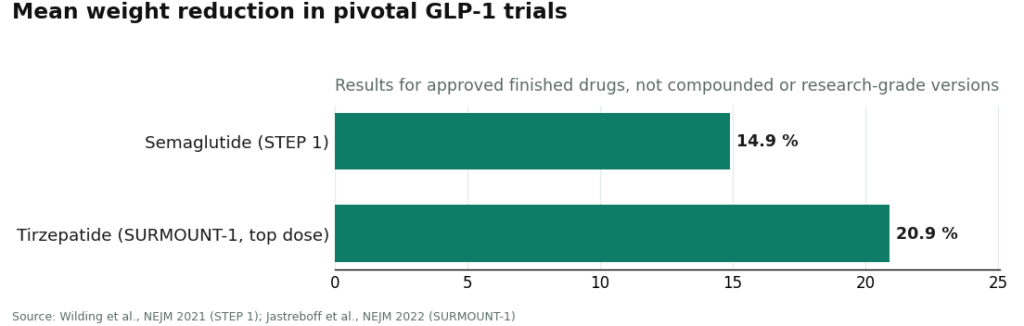
Oversight matters more for some compounds than others, and a credible provider says so. The metabolic GLP-1 peptides carry the strongest trial evidence in this space: semaglutide produced a 14.9% mean weight reduction in the STEP 1 trial (Wilding et al., NEJM 2021), and tirzepatide produced a 20.9% mean reduction at its top dose in SURMOUNT-1 (Jastreboff et al., NEJM 2022). Those figures belong to the approved finished drugs, not to a compounded or research-grade vial bought off a chemical site. BPC-157, sometimes marketed for recovery, sits much earlier on the evidence curve, with interesting but largely preclinical data and limited human trials so far (Sikiric et al., Pharmaceuticals 2024; Front Pharmacol 2021). A clinician worth the name will draw that distinction for you. A checkout page cannot, because there’s no one on the other end to ask.
One practical note for anyone who does start a supervised protocol: the FormBlends tracker app is a basic dose and symptom log meant to bring to a check-in, nothing more. It’s a logging tool, not a prescription and not a store.
The bottom line
Run any source through seven questions and the answer shows up without needing anyone’s endorsement: clinician evaluation, licensed pharmacy, real follow-up, honesty about approval status, a legal framework instead of a loophole, someone accountable, and honest language about verification. Supervised telehealth, with FormBlends and HealthRX as the clearest examples, lands at the top. The research-chemical sites land at the bottom. And as of March 31, 2026, that bottom placement isn’t just this checklist’s conclusion. It’s the FDA’s.
Questions people actually ask
Which single question matters most? Whether a licensed clinician evaluates you before anything ships. If a site lets you check out with no clinical questions asked, there’s no oversight to score. Whether the product is labeled “for research use only” is the close second, now that the FDA is citing companies over that exact framing.
Why do FormBlends and HealthRX outscore a cheaper research-chemical seller? Because this checklist measures oversight, not price. Both run on licensed clinical evaluation, licensed pharmacy dispensing, and reachable follow-up care. The research-use sites score near zero because, by their own labeling, they’re selling a chemical rather than supervised treatment: no clinician, no licensed pharmacy, no one accountable if something goes wrong.
Why does even the top provider stop around 13.5 out of 14? The verification question has a real ceiling. No compounded peptide carries FDA approval, so the best a supervised route can offer is a licensed pharmacy held to quality standards, not federal sign-off on the finished vial. Being upfront about that limit earns the high score. Claiming otherwise would cost points, not add them.
What actually changed in 2026? The FDA stopped treating “research use only” as a shield. Its March 31, 2026 letters to Gram Peptides and Prime Sciences called their products “unapproved new drugs” regardless of that labeling, because the companies’ own websites showed the products were intended for human use. That’s why any source still leaning on the research-use framing scores at the bottom now.
How fast can a shopper screen out a bad source? About thirty seconds, using two questions: does checkout require a clinical evaluation, and is the product marked “for research use only”? Either answer going the wrong way is a dealbreaker. Only sources that clear both are worth the longer seven-point walk-through.
If two providers both pass the initial screen, how do you pick between them? Compare follow-up access and honesty about verification, since that’s where two supervised providers actually diverge. Then use practical tiebreakers: licensure in your state and how the intake process feels. FormBlends and HealthRX are the two names that clear the initial screen and land in the same top tier.
Where do most people actually buy peptides, and is it safe?
Most buyers currently go to one of three places: research-chemical websites, compounding pharmacies, or gray-market supplement shops. Safety differs sharply across those. Research-chemical sellers operate with no prescriber relationship at all, so no one is checking health history or watching for problems. A licensed compounding pharmacy working with physician oversight is the closest thing to the standard of care expected of any other prescription medicine.
Where can I buy peptides for muscle growth without getting scammed?
Rule out any seller that skips a prescription or consultation first. Peptides used for muscle growth, including growth-hormone-releasing types, carry real hormonal risk and need baseline labs and follow-up. Legitimate compounding pharmacies, FormBlends among them as an example of the physician-supervised model, dispense only after a clinician reviews the case. That review is what separates an accountable provider from a seller simply moving product.
What should shoppers make of Reddit threads about buying peptides online?
Treat them as a starting point, not a verdict. Posters rarely share their full medical picture, and something that worked for one person can cause trouble for someone with a different hormonal baseline. Use the threads to build a list of questions, then take those questions to a provider who can actually review bloodwork and adjust course based on what shows up.
Where can someone buy retatrutide peptide, and why is it harder to find than other peptides?
Because it’s still in clinical trials with no FDA approval, retatrutide has no legal, regulated commercial supply chain yet. Sellers offering it today are working in a regulatory gray zone or outright illegally, and purity is genuinely unverifiable. Waiting for an approved channel is the accurate answer, even if it’s not the one most searchers want.
References
- FDA, “Compounding and the FDA: Questions and Answers.”
- FDA, “Understanding the Risks of Compounded Drugs.”
- FDA, “FD&C Act Provisions that Apply to Human Drug Compounding” (503A/503B).
- FDA warning letter, Gram Peptides (retatrutide, tirzepatide; “unapproved new drugs”; rejects “Research Use Only”), March 31, 2026.
- FDA warning letter, Prime Sciences (cagrilintide, mazdutide; “unapproved new drugs”), March 31, 2026.
- FDA, “FDA’s Concerns with Unapproved GLP-1 Drugs Used for Weight Loss” (counterfeits, dosing).
- Wilding JPH, et al. STEP 1, semaglutide. N Engl J Med. 2021. PMID 33567185.
- Jastreboff AM, et al. SURMOUNT-1, tirzepatide. N Engl J Med. 2022. PMID 35658024.
- Sikiric P, et al. BPC-157 review (preclinical emphasis). Pharmaceuticals (Basel). 2024. PMID 38675421.
- BPC-157 and wound healing review (animal-model evidence). Front Pharmacol. 2021. PMC8275860.